
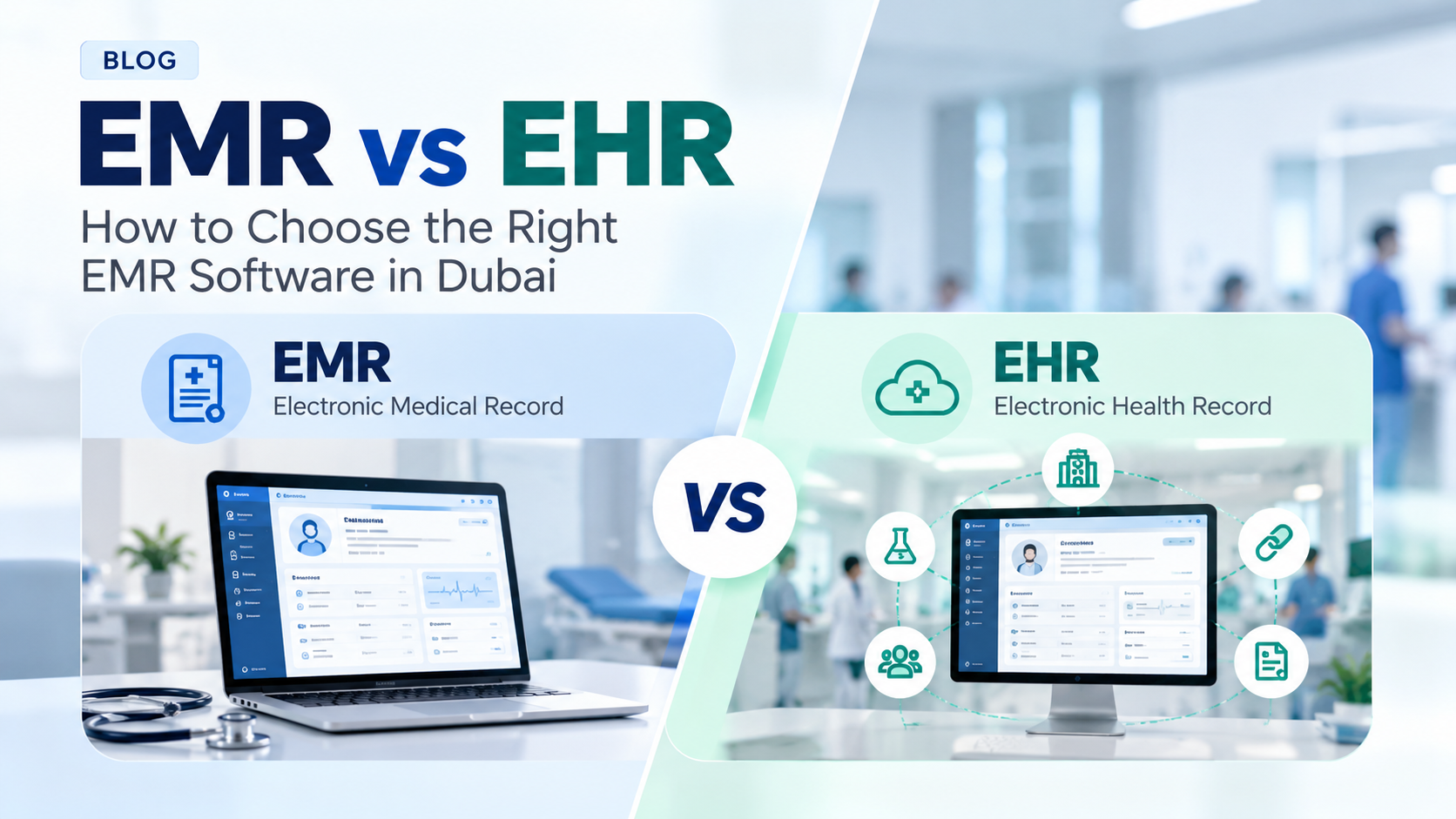
The healthcare industry in Dubai is embracing digital transformation to improve patient care, streamline clinical workflows, and enhance hospital management. From small medical clinics to multi-specialty hospitals, healthcare providers are increasingly adopting digital solutions to manage patient information efficiently.
Two important technologies supporting this transformation are Electronic Medical Records (EMR) and Electronic Health Records (EHR). Although these terms are often used interchangeably, they serve slightly different purposes in healthcare management.
Understanding the difference between EMR and EHR can help healthcare providers choose the right technology for their operational needs. With the right EMR software in Dubai, medical facilities can simplify documentation, improve access to patient information, and support better coordination between healthcare professionals.
In this guide, we explain the differences between EMR and EHR, their key benefits, and the important features healthcare providers should consider when selecting a digital medical records solution.
What Is EMR Software?
Electronic Medical Record (EMR) software is a digital system that enables healthcare providers to create, store, update, and manage patient medical records electronically. Instead of maintaining paper-based files, doctors and medical staff can access patient information through a centralized digital platform. This helps reduce administrative work and makes clinical documentation more organized and accessible.
Modern EMR software systems in Dubai can support several clinical activities, including:
- Patient medical history and clinical documentation
- Diagnoses and treatment plans
- Electronic prescriptions
- Laboratory results and radiology reports
- Allergy and medication records
- Follow-up appointments and clinical notes
- Integration with pharmacy and laboratory systems
For clinics, medical centers, and hospitals, an EMR system can simplify daily clinical workflows while helping healthcare professionals access relevant patient information when needed.
What Is EHR Software?
Electronic Health Record (EHR) software manages patient health information in a digital format designed to support continuity of care across healthcare providers and organizations.
While an EMR traditionally focuses on records maintained within a particular practice, an EHR is designed to support broader information sharing, subject to appropriate permissions, technical interoperability, and applicable regulations.
An electronic health records software solution may include:
- Patient medical history across multiple encounters
- Diagnoses, medications, and allergies
- Laboratory and diagnostic reports
- Treatment and care plans
- Clinical documentation from different providers
- Secure information exchange with connected healthcare systems
For healthcare organizations in Dubai, selecting an EHR-capable solution can be valuable when patient information needs to move securely between authorized healthcare professionals and connected systems.
EMR vs EHR: What Is the Difference?
Although EMR and EHR systems share many features, their traditional purposes differ.
| Feature | EMR Software | EHR Software |
|---|---|---|
| Primary purpose | Digital clinical records within a practice | Broader patient health information management |
| Information sharing | Often focused on a single organization | Designed to support sharing across providers |
| Patient history | Records maintained by a practice or facility | Can bring together information from multiple care settings |
| Clinical documentation | Diagnoses, prescriptions, and treatment notes | Similar records with a broader continuity-of-care focus |
| Integration | May connect with laboratory, pharmacy, and hospital systems | Designed to support interoperability with other authorized systems |
| Best suited for | Clinics, medical centers, and individual practices | Healthcare networks and organizations requiring coordinated care |
The distinction is not always absolute. Modern EMR platforms may also offer EHR-like information exchange capabilities, depending on their integrations and configuration. Therefore, healthcare providers should evaluate the actual features, interoperability, and regulatory requirements of a system rather than relying only on its product name.
Why Healthcare Providers in Dubai Need Modern EMR Software
Healthcare facilities manage large volumes of patient information, clinical documentation, appointments, prescriptions, and diagnostic reports every day. When these activities rely on disconnected applications or manual processes, staff may spend more time searching for information and completing repetitive administrative tasks.
Choosing suitable EMR management software in Dubai can help address these challenges.
1. Faster Access to Patient Information
A centralized digital record allows authorized healthcare professionals to retrieve patient histories, diagnoses, prescriptions, and available test results more efficiently. Having relevant information accessible during consultations can support clinical decision-making and reduce the need to search through paper files.
2. Improved Clinical Documentation
Digital documentation helps organize patient information in a consistent format. Doctors can record diagnoses, treatment plans, prescriptions, and consultation notes within the system. Structured documentation can also make it easier for authorized staff to review previous encounters and follow the patient’s treatment history.
3. Better Coordination Between Departments
Hospitals and multi-specialty medical centers often depend on communication between doctors, laboratories, pharmacies, radiology departments, and administrative teams. When an EMR integrates with these departments’ systems, authorized users can access relevant information without repeatedly entering the same data.
4. Reduced Administrative Work
Manual recordkeeping can involve repetitive data entry, document handling, and time-consuming record retrieval. Electronic medical records systems can streamline these activities and allow healthcare staff to focus more effectively on patient care and essential operational responsibilities.
5. Support for Healthcare Integration
Healthcare providers in Dubai should assess whether their chosen software supports the integrations required for their facility. Depending on the organization’s needs, this may include hospital information systems, laboratory information systems, pharmacy management, billing applications, and relevant health information exchange requirements. Integration capabilities should be verified with the software provider before implementation.
EMR Software vs HIS Software in Dubai
EMR and Hospital Information System (HIS) software are related, but they do not necessarily serve the same scope of operations. An EMR primarily manages clinical patient records, whereas a hospital information system can coordinate clinical, administrative, financial, and operational activities across a hospital.
A comprehensive HIS may include:
- Patient registration and appointment scheduling
- Electronic medical records
- Laboratory Information System (LIS)
- Pharmacy management
- Radiology management
- Billing and insurance workflows
- Inpatient and outpatient management
- Inventory and operational reporting
For a small clinic, an EMR solution may meet its primary clinical documentation requirements. A large hospital with multiple departments may need a broader HIS platform that connects clinical records with operational processes. Healthcare providers comparing HIS software in Dubai should evaluate whether the system can integrate the required departments and support their facility’s current and future needs.
Essential Features to Look for in EMR Software Systems in Dubai
Before investing in an EMR solution, healthcare organizations should evaluate the following capabilities.
Secure Patient Record Management
The system should support appropriate access controls, secure data handling, audit trails, and reliable backup and recovery processes. Healthcare organizations should also verify that the solution supports their applicable data protection and healthcare regulatory obligations.
Specialty-Based Clinical Documentation
Different medical specialties have different documentation requirements. A suitable EMR system should accommodate the workflows and clinical information relevant to the facility’s services.
Laboratory and Pharmacy Integration
Integration with laboratory and pharmacy systems can help authorized users access relevant test results, medication information, and related clinical records more efficiently. The availability and scope of these integrations should be confirmed during product evaluation.
Reporting and Analytics
Reporting capabilities can help healthcare managers review operational activity, patient volumes, and other relevant performance indicators. Useful reports can support better planning and help identify opportunities to improve workflows.
Scalability and Customization
Healthcare organizations may expand their services, introduce new specialties, or open additional branches over time. Choosing flexible EMR software systems in Dubai can help organizations accommodate changing requirements without unnecessarily disrupting existing operations.
Regulatory and Interoperability Requirements
Healthcare facilities should confirm whether the software supports the specific regulatory, reporting, and integration requirements applicable to their location and license. For Dubai facilities, this may include assessing requirements associated with NABIDH connectivity where applicable. Providers should verify the current requirements with the relevant authority and software vendor.
How to Choose the Right Electronic Medical Records System in Dubai
Selecting the right system requires more than comparing software features or subscription prices. Healthcare providers should begin by identifying their operational requirements and then evaluate how well each solution meets them.
Consider these five steps:
Step 1: Identify your clinical requirements. Determine which departments, specialties, and patient workflows the system must support.
Step 2: Evaluate integration capabilities. Check whether the software can connect with the laboratory, pharmacy, billing, and other systems your facility uses.
Step 3: Review security and compliance. Assess access controls, audit logs, backup procedures, data protection, and applicable regulatory requirements.
Step 4: Assess usability and training. Request a demonstration to understand how easily doctors, nurses, and administrative staff can complete everyday tasks.
Step 5: Consider long-term scalability. Evaluate implementation support, customization options, maintenance, and the ability to accommodate future growth.
A structured evaluation can help healthcare organizations select an electronic medical records system in Dubai that aligns with their clinical and operational priorities.
How Sapiens Supports Digital Healthcare Management
Sapiens Software provides healthcare technology solutions designed to support clinical documentation and healthcare operations. Its EMR solutions help healthcare providers manage patient information, clinical notes, prescriptions, and diagnostic records through digital workflows.
The company also offers broader healthcare software capabilities, including hospital information system solutions and integration with other healthcare management functions.
For healthcare organizations evaluating EMR software in Dubai, Sapiens can be considered as part of the vendor evaluation process. Providers should review the available features, implementation requirements, integration options, and regulatory suitability against their specific needs.
Explore the Sapiens Electronic Medical Record solutions to learn more about its EMR capabilities. You can also explore Hospital Information System Software in Dubai for a broader view of hospital management solutions.
Conclusion
EMR and EHR technologies play an important role in modern healthcare by helping providers organize patient information, improve documentation, and support coordinated clinical workflows.
While EMR software traditionally focuses on records maintained within a practice, EHR systems are designed to support broader information sharing across healthcare settings. A hospital information system can extend these capabilities by connecting patient records with clinical departments and hospital operations.
For healthcare providers in Dubai, the right solution should align with clinical workflows, integration requirements, security needs, and applicable regulations.
By evaluating these factors carefully, clinics and hospitals can identify EMR software in Dubai that supports efficient healthcare management and long-term digital transformation.
Looking for a suitable EMR solution for your healthcare facility? Explore Sapiens Software’s EMR solutions to understand the available capabilities and discuss your organization’s requirements with its team.