
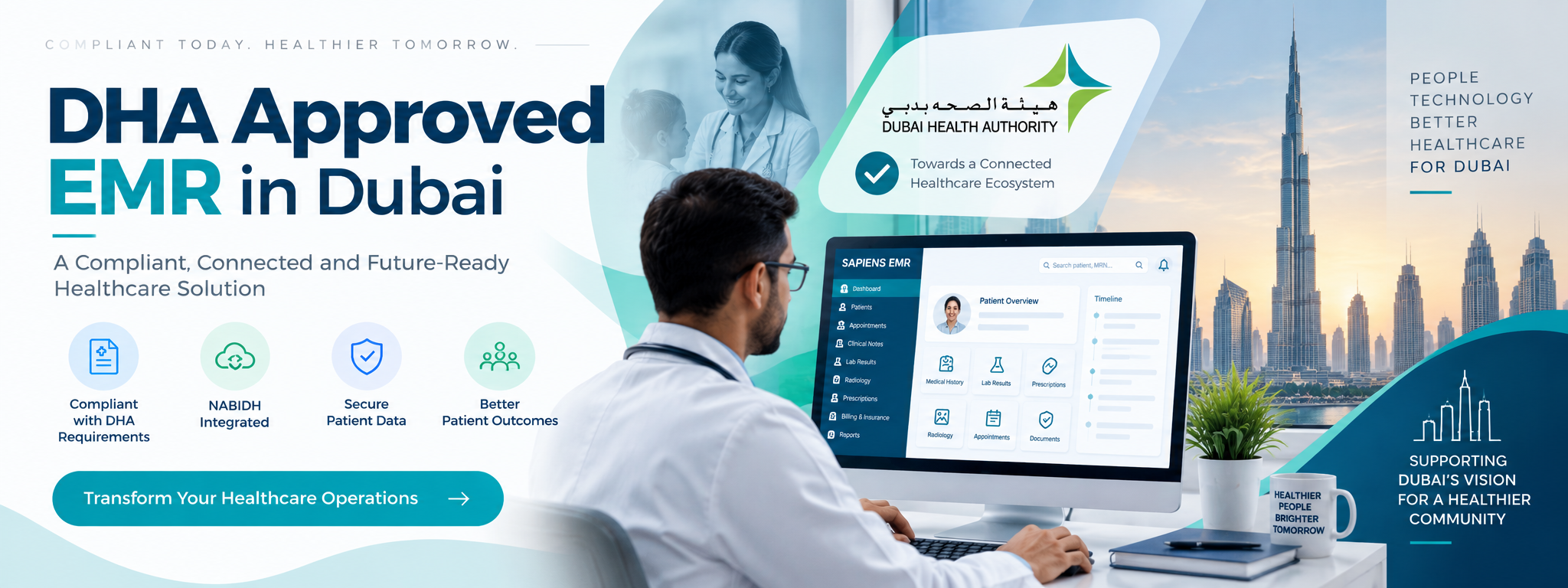
Dubai’s healthcare industry is rapidly moving toward connected digital healthcare, making a reliable Electronic Medical Record (EMR) system an essential part of modern hospital and clinic operations. For healthcare providers operating under the Dubai Health Authority (DHA), choosing an EMR is not simply about digitizing patient records. The system needs to support interoperability, secure access, health information exchange, and the applicable digital healthcare requirements in Dubai.
This has increased demand for DHA Approved EMR and DHA compliant EMR software in Dubai that can support healthcare organizations as they move toward a more connected digital environment.
What Is a DHA-Compliant EMR?
A DHA-compliant EMR is an electronic medical record system designed to support the requirements applicable to healthcare facilities operating within Dubai’s healthcare ecosystem. DHA’s current EMR guidance places emphasis on interoperability, authentication and authorization, privacy, confidentiality, audit trails, and the ability to connect with NABIDH. DHA’s 2025 circular specifically addresses implementation of an EMR system compliant with NABIDH integration requirements and Single Sign-On authentication.
This means healthcare organizations should look beyond basic EMR functionality when evaluating software. The ability to securely exchange healthcare information and integrate with Dubai’s digital health infrastructure is an important part of the selection process.
Why DHA Compliance Matters for Healthcare Providers in Dubai
Hospitals, clinics, medical center, and other healthcare facilities manage sensitive patient information every day. An EMR system must therefore support reliable documentation while maintaining appropriate controls over who can access and modify healthcare information. DHA’s interoperability standards define an EMR as a system that manages electronic health information in a digital format and supports information exchange through secure networks.
For healthcare providers, this means that an EMR should be considered a core component of the overall healthcare information system rather than simply a digital replacement for paper files.
A properly designed EMR can help doctors access patient history, diagnoses, prescriptions, laboratory information, radiology reports, treatment plans, and other clinical information from a centralized system.
DHA EMR and NABIDH Integration
One of the most important considerations for healthcare providers looking for a DHA compliant EMR in Dubai is NABIDH integration. NABIDH is Dubai’s Health Information Exchange platform for securely exchanging medical records between healthcare providers. DHA’s NABIDH platform enables healthcare facilities to connect their Electronic Medical Record systems to the wider healthcare information exchange.
DHA’s EMR transition guidance also states that a new EMR should have the capability for Single Sign-On to connect to NABIDH and should be interoperable in terms of the syntax and semantics of exchanged information.
For this reason, healthcare organizations evaluating DHA Approved EMR software should pay close attention to the platform’s NABIDH integration capabilities.
What Should You Look for in a DHA-Compliant EMR?
A modern DHA EMR software solution should combine clinical functionality with interoperability and security. Doctors should be able to document consultations, diagnoses, treatment plans, prescriptions, and clinical observations without unnecessary administrative complexity. At the same time, the system should allow relevant information to connect with laboratory, radiology, pharmacy, billing, insurance, and other healthcare workflows.
Security is equally important. DHA guidance highlights user authentication and authorization, privacy, confidentiality, and audit trails as important EMR capabilities.
This makes it important to evaluate not only what the EMR can do, but also how it controls access to patient information and records user activity.
From Patient Records to Connected Healthcare
A modern EMR should not operate as an isolated patient-record database. Consider a typical healthcare journey. A patient visits a doctor, receives a diagnosis, undergoes laboratory or radiology investigations, receives a prescription, and eventually generates billing and insurance transactions.
When these processes are connected, information can move between departments more efficiently. Doctors can access investigation results, pharmacy teams can process prescriptions, billing teams can work with clinical services, and insurance teams can use relevant information for claims processing.
This integrated approach makes DHA compliant EMR software Dubai providers more valuable than systems that only focus on storing patient records.
Electronic Health Records and DHA Requirements
The terms EMR and EHR are often used interchangeably, but healthcare organizations should also consider interoperability when choosing a digital health platform. An EMR generally manages electronic medical information within a healthcare organization, while an EHR represents a broader connected approach to health information.
For healthcare providers searching for electronic health records software in Dubai, the ability to exchange relevant information securely is therefore an important consideration.
Dubai’s NABIDH ecosystem is built around connecting healthcare providers and enabling access to trusted healthcare information, making interoperability increasingly important for modern healthcare technology.
How Sapiens Supports DHA-Focused Healthcare Operations
Sapiens Software provides integrated healthcare software for hospitals, polyclinics, pharmacies, laboratories, and other healthcare organizations.
Its healthcare platform includes Electronic Medical Records alongside laboratory information systems, radiology, pharmacy management, insurance, e-claims, medical billing, nursing, inventory, operation theatre management, finance, reporting, dashboards, and business intelligence. Sapiens also describes its platform as a cost-effective NABIDH-integrated healthcare system.
This integrated approach allows healthcare organizations to manage clinical and administrative workflows through a connected healthcare platform rather than relying on multiple disconnected applications. For organizations evaluating DHA compliant EMR software in Dubai, this combination of EMR, healthcare modules, interoperability, and implementation support can provide a foundation for digital healthcare transformation.
Why NABIDH-Ready EMR Is Important for Dubai
Healthcare interoperability is becoming increasingly important across Dubai. NABIDH provides a secure platform for exchanging trusted healthcare information across public and private healthcare facilities, supporting unified medical records and connected clinicians.
Therefore, healthcare organizations planning to implement or replace an EMR should consider whether their chosen platform can support current interoperability requirements and future digital healthcare initiatives. An EMR that is designed with interoperability in mind can make it easier for healthcare providers to participate in Dubai’s connected healthcare ecosystem.
Choosing the Right DHA EMR Software
Selecting an EMR should begin with the healthcare organization’s operational and regulatory requirements. Hospitals and clinics should evaluate how the system handles clinical documentation, user authentication, access controls, audit trails, interoperability, NABIDH connectivity, laboratory and radiology integration, pharmacy, insurance, billing, reporting, and scalability.
The implementation process should also receive attention. Even a technically capable EMR can create challenges if staff are not properly trained or if existing systems and data are not handled correctly during implementation.
A healthcare technology provider should therefore be able to support implementation, configuration, integration, training, and ongoing technical support.
The Future of DHA-Compliant EMR Software in Dubai
Healthcare technology in Dubai is moving toward increasingly connected systems. EMR platforms are becoming part of a broader digital healthcare infrastructure that connects healthcare facilities, clinicians, patient information, diagnostics, insurance, pharmacy, and other services.
Future-ready EMR platforms will therefore need to support more than electronic documentation. Interoperability, automation, analytics, secure data exchange, and intelligent healthcare workflows will increasingly shape how hospitals and clinics manage patient information. For healthcare providers, investing in an EMR that can evolve with Dubai’s digital healthcare ecosystem can provide greater long-term value.
Conclusion
A DHA Approved EMR is often searched for by healthcare organizations looking for a reliable and compliant digital medical records solution in Dubai. However, healthcare providers should look beyond the term “approved” and evaluate whether an EMR supports the actual requirements relevant to their facility, including interoperability, NABIDH integration, secure authentication, privacy, confidentiality, and auditability.
Sapiens provides integrated EMR software in Dubai designed to connect patient records with broader healthcare operations. With EMR, laboratory, radiology, pharmacy, billing, insurance, nursing, inventory, and other healthcare modules available within its platform, Sapiens helps healthcare organizations move toward a more connected digital healthcare environment.
For healthcare organizations looking for DHA compliant EMR software in Dubai, DHA EMR software, or a NABIDH-integrated EMR, Sapiens can provide a scalable healthcare technology platform tailored to organizational requirements.
Frequently Asked Questions
1. What is a DHA-approved EMR?
The phrase “DHA-approved EMR” is commonly used to describe EMR software intended to meet applicable Dubai healthcare requirements. Healthcare providers should verify the vendor’s specific DHA/NABIDH documentation rather than relying solely on the term “approved.”
2. Is NABIDH integration important for EMR software in Dubai?
Yes. NABIDH is Dubai’s health information exchange platform, and DHA has issued requirements and guidance concerning EMR integration with NABIDH.
3. What security features should a DHA-compliant EMR have?
Healthcare providers should evaluate authentication, authorization, access controls, privacy, confidentiality, audit trails, and other applicable security measures. DHA’s EMR guidance specifically highlights these areas.
4. Can Sapiens EMR integrate with NABIDH?
Sapiens describes its healthcare platform as a NABIDH-integrated system and provides EMR and broader healthcare management functionality for Dubai healthcare organizations.
5. Can DHA EMR software be used by clinics?
Yes. EMR solutions can support clinics, polyclinics, medical centers, specialty centers, and hospitals, provided the implementation is configured for the organization’s workflows and applicable requirements.
6. Is DHA compliance the same as NABIDH integration?
No. They should not be treated as identical terms. NABIDH is Dubai’s health information exchange platform, while DHA establishes healthcare standards, requirements, and guidance. An EMR may need to meet multiple applicable requirements, including interoperability and NABIDH integration.