
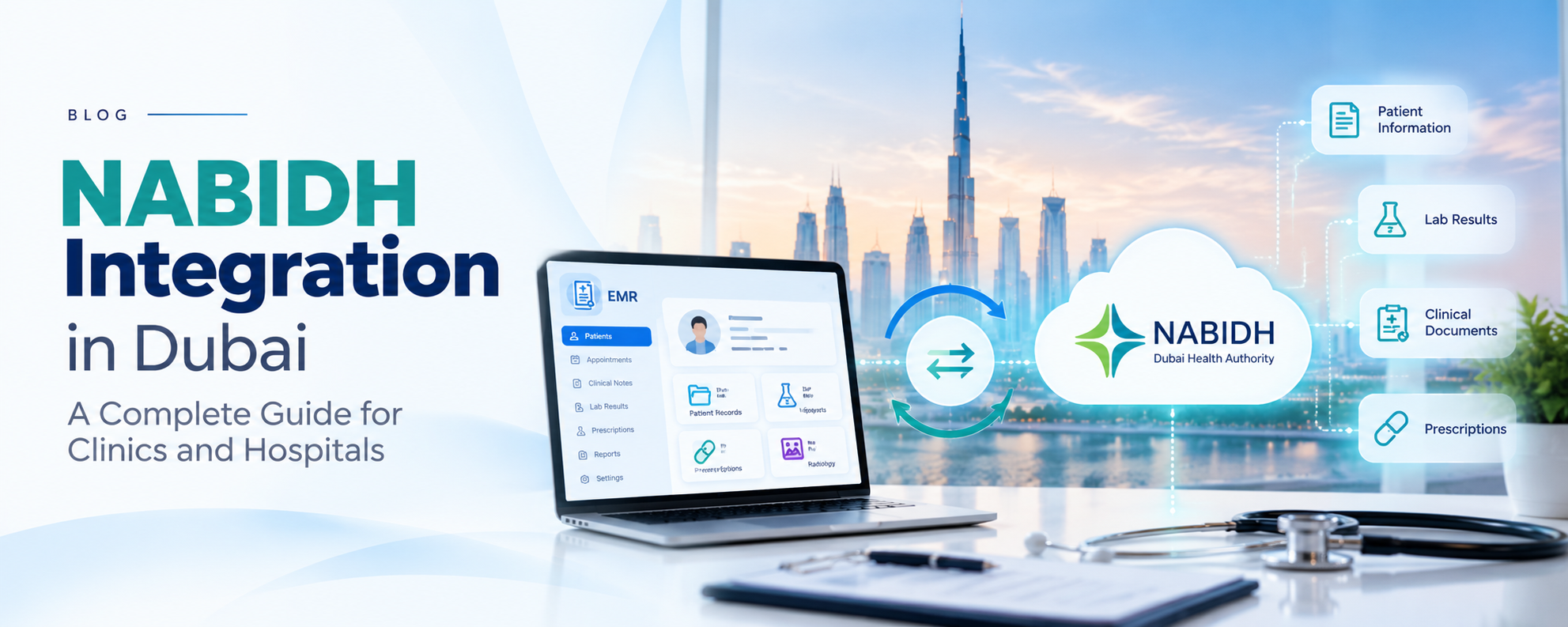
Dubai’s healthcare industry is moving toward connected digital healthcare, where secure access to patient information and efficient data exchange play an important role in improving care delivery. For clinics, hospitals, and medical centers, integrating their Electronic Medical Record (EMR) systems with NABIDH is an important part of this digital transformation.
NABIDH, the National Backbone for Integrated Dubai Health, is Dubai’s health information exchange platform. It supports the secure exchange of health information between connected healthcare providers, helping authorized professionals access relevant patient information across participating facilities.
For healthcare organizations, successful NABIDH integration involves more than connecting software systems. It requires appropriate EMR capabilities, accurate patient information, standardized clinical data, technical testing, and ongoing monitoring.
In this guide, we explain how NABIDH integration works, the key preparation steps for healthcare facilities, common implementation challenges, and how to evaluate EMR software in Dubai for integration requirements.
What Is NABIDH Integration?
NABIDH integration connects a healthcare facility’s EMR system with Dubai’s health information exchange platform so that relevant clinical information can be exchanged according to applicable technical specifications and policies. Instead of relying entirely on isolated records maintained by individual facilities, connected healthcare systems can support more coordinated access to patient information.
Depending on the approved integration scope, clinical information may include:
- Patient demographic information
- Medical encounters and clinical documentation
- Diagnoses and treatment-related information
- Laboratory and diagnostic results
- Other supported clinical information
The information exchanged depends on the facility’s implementation, the EMR system’s capabilities, and the applicable NABIDH specifications. For healthcare providers in Dubai, selecting an EMR system that supports the required integration workflows can help simplify implementation and ongoing operations.
Why Is NABIDH Integration Important for Healthcare Providers in Dubai?
1. Better Access to Patient Information
Connected health information systems can help authorized healthcare professionals access relevant patient information from participating providers. This can be particularly useful when patients visit different clinics, specialists, or hospitals during their treatment journey.
2. Improved Continuity of Care
Access to relevant medical history can help healthcare professionals understand previous consultations, diagnoses, and available test results. When supported by accurate data and appropriate access permissions, information exchange can contribute to better-coordinated care.
3. More Efficient Clinical Workflows
An appropriately configured EMR can reduce repetitive documentation and support structured capture of clinical information. Integration can also help reduce disconnected workflows between clinical documentation and health information exchange processes.
4. Support for Healthcare Regulatory Requirements
Healthcare facilities should assess the NABIDH requirements applicable to their facility type and licensing circumstances. The Dubai Health Authority publishes policies, standards, and onboarding resources that healthcare organizations should consult before planning their integration. Integration readiness should be verified against current official requirements rather than assumed from a software product description alone.
How Does NABIDH Integration Work?
NABIDH integration generally involves connecting a facility’s clinical system to the health information exchange through the required technical interfaces, data formats, and validation processes.
A typical implementation includes the following activities.
Step 1: Assess Your Existing EMR System
Begin by reviewing the current EMR software and its integration capabilities. Check whether the system can support the required patient information, clinical documentation, data mapping, security controls, and technical interfaces. Healthcare providers should also confirm which types of clinical information the vendor can support for the intended integration.
Step 2: Review Facility Onboarding Requirements
Healthcare facilities should review the official NABIDH onboarding process and applicable DHA requirements. Prepare the relevant facility information, licensing details, and documentation required for the onboarding process. The facility should confirm its specific requirements directly through the official NABIDH portal.
Step 3: Prepare and Standardize Patient Data
Accurate data is essential for reliable healthcare information exchange. Before integration testing, review patient demographics, identifiers, clinical terminology, and other required fields. Identify incomplete records, inconsistent formats, and potential duplicate patient files. Data preparation should be treated as a core implementation activity rather than something to address only after the connection is established.
Step 4: Configure the Integration
The healthcare software provider and technical team configure the connection according to the applicable NABIDH specifications. Depending on the implementation, this may involve message structures, field mappings, clinical codes, facility identifiers, and validation rules. The team should confirm the supported interface and required data elements using the latest official technical documentation.
Step 5: Test and Validate the Integration
Before production use, validate the integration in the appropriate testing environment. Testing should cover required data fields, message validation, patient identification, supported clinical information, error handling, and the correction of rejected transactions. The implementation team should document testing results and resolve identified issues before progressing through the required approval and go-live process.
Step 6: Monitor the Integration After Go-Live
Integration does not end when the system becomes operational. Healthcare facilities should establish a process for reviewing integration errors, correcting incomplete records, monitoring data exchange, and escalating technical issues. Regular monitoring helps teams identify problems early and maintain the quality of exchanged information.
Common NABIDH Integration Challenges
Even when an EMR system supports integration, problems can arise from data quality, configuration, or operational processes.
Incomplete Patient Information
Missing or inconsistent patient identifiers and demographic details can create difficulties in patient matching and data validation. Recommended approach: Establish a consistent registration process and validate required patient information at the point of entry.
Inconsistent Clinical Coding
Unstructured clinical entries may not meet the coding and terminology requirements of the integration.
Recommended approach: Review the applicable terminology standards and configure the EMR to capture the required structured clinical data.
Incorrect System Configuration
Incorrect facility details, field mappings, or other configuration settings may cause validation failures. Recommended approach: Maintain documented configuration settings and validate them during testing and whenever relevant changes are introduced.
Limited Error Monitoring
If integration errors are not reviewed regularly, rejected or incomplete transactions may remain unresolved.
Recommended approach: Assign responsibility for monitoring integration status, investigating errors, and documenting corrective actions.
Insufficient Staff Training
Front-desk staff, clinicians, and administrators all contribute to the accuracy of healthcare information.
Recommended approach: Provide role-specific training for patient registration, clinical documentation, data correction, and escalation procedures.
NABIDH Integration Checklist for Clinics and Hospitals
Before proceeding with an integration project, healthcare providers should review the following checklist.
- Confirm the applicable NABIDH onboarding requirements.
- Evaluate the EMR vendor’s supported integration capabilities.
- Identify the clinical information required for exchange.
- Review patient demographics and data quality.
- Validate the necessary terminology and field mappings.
- Confirm security, privacy, and access-control arrangements.
- Complete the required technical testing and validation.
- Train relevant clinical and administrative staff.
- Assign ownership for monitoring integration errors.
- Review current DHA policies and technical specifications before implementation.
Completing these activities can help healthcare organizations prepare for a more structured implementation process.
How to Choose EMR Software for NABIDH Integration in Dubai
Selecting suitable EMR software is an important decision for clinics and hospitals planning NABIDH integration. Healthcare providers should evaluate more than the availability of an integration feature. They should assess the vendor’s technical capabilities, implementation process, ongoing support, and suitability for their clinical workflows.
Important factors include:
Integration capabilities: Confirm which interfaces, data types, and workflows the system supports.
Clinical data quality: Evaluate how the software captures patient demographics, diagnoses, and other structured clinical information.
Security and access controls: Review authentication, permissions, audit trails, and relevant data protection capabilities.
Testing and implementation support: Understand how the vendor assists with configuration, validation, issue resolution, and go-live preparation.
Ongoing maintenance: Confirm how the vendor manages updates, technical issues, and changes to applicable specifications.
Scalability: Consider whether the platform can support additional departments, facilities, and clinical workflows as the organization grows.
Healthcare providers should request a technical demonstration and verify integration claims against their own requirements before making a purchasing decision.
How Sapiens Supports Connected Healthcare Management
Sapiens Software provides healthcare technology solutions for hospitals, clinics, laboratories, and other healthcare organizations. Its healthcare platform includes Electronic Medical Records and broader hospital management capabilities. The company’s published EMR information describes support for NABIDH-related healthcare integration, while its wider software offering includes modules for laboratory management, pharmacy management, radiology, billing, and other hospital operations.
These capabilities can be relevant to healthcare providers seeking a more connected approach to clinical and administrative workflows. When evaluating Sapiens for a NABIDH integration project, healthcare organizations should discuss their facility requirements, integration scope, technical specifications, implementation process, and ongoing support needs with the Sapiens team.
Explore the Sapiens Electronic Medical Record solution to learn more about its EMR capabilities. You can also review the company’s healthcare integration services to explore its broader integration offering.
Frequently Asked Questions
1. What is NABIDH in Dubai?
NABIDH is Dubai’s health information exchange platform, developed to support the exchange of health information between connected healthcare providers.
2. Is NABIDH integration required for every healthcare facility in Dubai?
Requirements depend on the applicable DHA policies, facility category, and licensing circumstances. Healthcare providers should verify the current requirements directly with the Dubai Health Authority.
3. What should an EMR system support for NABIDH integration?
The system should support the applicable technical specifications, required clinical data, relevant interfaces, validation processes, and security controls. The precise requirements should be confirmed against current official documentation.
4. How long does NABIDH integration take?
The timeline varies according to vendor readiness, facility onboarding, data quality, configuration requirements, testing, and the relevant approval process. A reliable timeline should be established after a technical assessment.
5. Can existing EMR software be integrated with NABIDH?
Potentially, yes. The feasibility depends on the existing system’s architecture, supported interfaces, data structures, and ability to meet current requirements. A technical assessment is recommended before implementation.
6. Is NABIDH the same as eClaimLink?
No. NABIDH is a health information exchange platform for clinical information. eClaimLink supports healthcare insurance-related transactions. Healthcare organizations should assess the requirements for each platform separately.
Conclusion
NABIDH integration is an important consideration for healthcare providers working toward connected digital healthcare in Dubai. A successful implementation requires suitable EMR software, accurate patient data, appropriate technical configuration, thorough testing, and ongoing monitoring.
By preparing carefully and verifying the current DHA requirements, clinics and hospitals can make more informed decisions about their healthcare integration projects. Sapiens provides EMR and healthcare management software capabilities that healthcare organizations can evaluate when planning their digital healthcare infrastructure.
Planning a NABIDH integration project? Contact Sapiens to discuss your facility’s EMR requirements and explore suitable healthcare software options.