
Running a pharmacy in Dubai has never been more demanding.
Pharmacists deal with manual record-keeping, stock errors, delayed billing, insurance claim issues, and strict regulatory requirements, all at the same time. And as patient volumes grow, these problems compound fast.
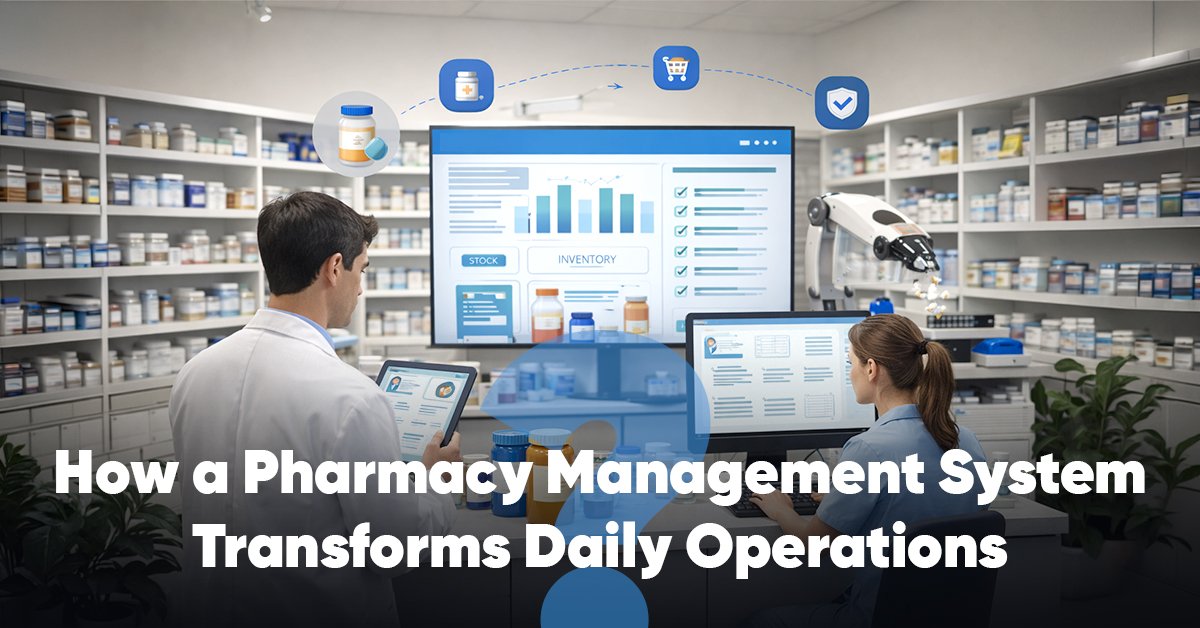
A Pharmacy Management System (PMS) addresses all of this in one place. It connects your inventory, billing, prescriptions, and compliance tools into a single platform, so your team spends less time fixing errors and more time serving patients.
In this article, we’ll discuss how smart pharmacy software is transforming day-to-day operations in Dubai, the key features to look for in a Pharmacy Management System, and how the right solution can improve accuracy, compliance, and overall efficiency for modern pharmacies.
What Is a Pharmacy Management System?
Pharmacy software is a digital platform built to manage the day-to-day operations of a pharmacy.
It replaces paper-based processes and disconnected tools with one system that handles everything from stock control to patient records.
At its core, a PMS centralizes three key areas: inventory management, billing and point-of-sale, and prescription processing.
In the UAE, pharmacies operate under tight regulatory oversight; having all of this in one place is more than necessary.
Common Challenges in Pharmacy Operations
Most pharmacy challenges in the UAE stem from the same root causes.
Manual inventory tracking leads to stockouts, expired medicines sitting on shelves, and over-ordering. Without real-time visibility, it’s hard to know what you have until it’s too late.
Billing errors slow down the checkout process and create problems with insurance claims. A single wrong code can delay reimbursements for weeks.
No real-time reporting means managers are making decisions based on outdated data. That affects purchasing, staffing, and financial planning.
Regulatory compliance is another pressure point. UAE authorities require accurate dispensing records, proper documentation, and controlled substance tracking. Manual systems make this hard to maintain consistently.
Poor patient history tracking increases the risk of dispensing errors. Without access to a patient’s full medication history, catching dangerous interactions falls on the pharmacist’s memory alone.
Key Features of a Modern Pharmacy Management System
Inventory & Stock Control
A good system tracks medicines in real time; every sale, return, and purchase order is logged instantly. When stock falls below a set threshold, the system sends an alert or triggers an automatic reorder. This cuts down on both stockouts and waste.
Prescription Management
Prescriptions are entered digitally, reducing transcription errors. The system also checks for drug interactions and validates prescriptions before dispensing. This adds a layer of safety that manual checks can miss.
Billing & POS Integration
Faster billing means shorter queues. Integrated barcode scanning speeds up the checkout process and reduces keying errors. The system handles pricing, discounts, and VAT automatically.
Insurance & Claims Processing
Electronic insurance claims go out faster and with fewer errors. Automated claim processing reduces back-and-forth with insurers and speeds up reimbursements which matters a lot for cash flow.
Reporting & Analytics
Sales reports, inventory summaries, and profit and loss statements are generated automatically. Managers can view daily performance or pull historical data without digging through spreadsheets.
Benefits of a Pharmacy Management System
The benefits of using a pharmacy management system are clear.
Workflows become faster because staff aren’t hunting through paper records or correcting manual errors. Patients get served more quickly. And human error in dispensing, billing, and documentation drops significantly.
From a financial standpoint, better inventory forecasting reduces waste and prevents capital from sitting in slow-moving stock. Accurate reporting gives owners a clearer picture of margins and performance.
For UAE pharmacies specifically, compliance with Ministry of Health regulations becomes much easier to maintain. The system logs what was dispensed, to whom, and when. Exactly what auditors need to see!
How Pharmacy Software Improves Patient Safety
This is where the technology has the most direct impact on people.
Dispensing errors like giving a patient the wrong medicine or the wrong dose are one of the most serious risks in pharmacy. A PMS reduces these errors by digitizing the prescription workflow and adding validation steps before anything reaches the patient.
Drug interaction flagging is built into most drug interaction software. When a pharmacist enters a prescription, the software checks it against the patient’s existing medications and alerts the team to any dangerous combinations.
And because patient medication history is stored and accessible, pharmacists can make informed decisions quickly without needing to rely on what the patient remembers.
Technology Trends in Pharmacy Management
Cloud-based pharmacy softwares are becoming the standard. They’re easier to maintain, don’t require on-site servers, and allow data to be accessed securely from any location.
Mobile app integration lets pharmacists check stock levels, view reports, and receive alerts from their phones. This is especially useful for managers overseeing multiple branches.
Real-time notifications keep staff informed like low stock alerts, pending approvals, and expiry warnings, without anyone needing to check manually.
Integration with hospital EMR systems is increasingly important in Dubai. When a pharmacy connects directly with a hospital’s electronic medical records, prescription data flows through without manual re-entry, cutting errors and saving time.
Choosing the Right Pharmacy Management System in UAE
Scalability & Customization
Your needs today won’t be the same in two years. Look for a system that can grow with you such as adding users, branches, or features without requiring a full replacement. Customization matters too; your workflows may not fit a generic template.
Integration with Other Healthcare Systems
A system that works in isolation creates new problems. Check whether the software connects with your hospital network, insurance providers, and government health platforms used in the UAE.
Local Support & Implementation Services
Software is only useful if your team knows how to use it. Look for a vendor with a local presence in the UAE who can provide hands-on training and be available when issues come up.
Data Security & Compliance
Patient data is sensitive. The system you choose should meet UAE data protection standards and give you control over who can access what information. Regular backups and audit logs are non-negotiable.
Pricing & ROI Expectations
Cost matters, but so does value. A cheaper system that causes billing errors or compliance issues can cost more in the long run. Ask vendors for a clear breakdown of implementation costs, licensing fees, and ongoing support charges, and weigh that against the time and errors you’ll save.
Why Sapiens Info Pharmacy Management System Stands Out
Sapiens Info has built its pharmacy solution specifically for the UAE healthcare market. That means the software is designed around local regulatory requirements, insurance structures, and operational norms, and not adapted from a system built for another market.
The platform works for pharmacies of different sizes. Whether you’re running a single-branch community pharmacy or managing operations across a hospital network, the system can be configured to fit.
Integration is another strength. Sapiens Info’s PMS connects with other healthcare modules such as patient management, billing, and EMR, so data doesn’t get siloed. And because implementation is handled locally, onboarding is faster, and support is accessible when you need it.
The reporting and analytics tools give owners and managers the data they need to make informed decisions: sales trends, top-performing products, stock movement, and financial summaries all in one view.
Real Use Cases
A busy retail pharmacy in Dubai was struggling with daily stockouts and long checkout queues. After switching to an automated pharmacy management system, they cut checkout time by setting up barcode-based billing and reduced stockouts through automatic reorder triggers. Staff reported spending significantly less time on manual counts.
A hospital pharmacy needed to connect with the hospital’s EMR system to receive prescriptions digitally. After integration, prescription errors dropped, and the time between a doctor writing a prescription and the patient receiving medication shortened considerably.
A pharmacy facing a compliance audit was able to produce complete dispensing records, controlled substance logs, and patient history documentation within hours, all pulled directly from the system. What would have taken days of manual retrieval was done quickly and accurately.
Conclusion
Running a pharmacy in Dubai without the right software puts you at a disadvantage.
Manual processes slow your team down, create errors, and make compliance harder than it needs to be.
A pharmacy management system fixes the core problems such as inventory, billing, prescriptions, and reporting, in one place. And with the right vendor, implementation is straightforward, and support is local.
If you’re ready to move your pharmacy operations forward, Sapiens Info’s pharmacy management system is worth a closer look. It’s built for the UAE market, scales with your business, and connects with the systems you already use.
Upgrade from manual chaos to smart, compliant, and future-ready pharmacy operations with the right PMS!